Shipments go out the door every day without anyone knowing where they are until something goes wrong. That blind spot costs businesses more than they realize, in missed deliveries, customer calls, disputed proof of delivery, and eroded trust. Driver tracking closes that gap. It gives dispatchers, shippers, and customers a real-time, accurate picture of every driver’s location and delivery status, from the moment a load is assigned to the second proof of delivery is captured.
This blog covers how driver tracking works in 2026, what to look for in a driver tracking app, how CDL tracking and last-mile delivery tracking differ, and why businesses across Ohio, Michigan, Pennsylvania, Indiana, Kentucky, New York, and Florida are making it a baseline operational requirement.
Key Takeaways
- 80% of fleet professionals now rely on GPS fleet tracking technology, an 11-percentage-point increase year over year.
- Tracking and order visibility are important to 90% of customers, making real-time tracking a non-negotiable aspect of delivery, per Transvirtual’s 2026 last-mile research.
- WISMO (“Where Is My Order?”) inquiries drive 25 to 35% of all contact center interactions and can spike to 50% during peak periods, a problem driver tracking addresses at the source.
- Fleets using GPS tracking technology report average cost decreases of 11–19% across fuel, accidents, labor, and maintenance expenses.
- 44% of GPS fleet tracking users report improved productivity, and nearly half of users across major tracking technologies see ROI in less than one year.
What is Driver Tracking?
Driver tracking is the use of GPS or cellular technology to monitor a driver’s real-time location, route history, and delivery status. At its simplest, it shows a dispatcher a live dot on a map. At its most capable, it delivers live ETAs, route deviation alerts, driver behavior scoring, digital proof of delivery, and full historical route playback, all without a single phone call to the driver.
Modern driver tracking operates in two primary modes:
Active tracking transmits location data continuously, typically every 10 to 30 seconds. This is the standard for same-day delivery, CDL last-mile tracking, and any operation where customers expect live ETAs and real-time status.
Passive tracking records location data locally and uploads it after the vehicle returns to base. This works for smaller operations that don’t require real-time customer visibility, but active tracking systems are now the industry standard, reflecting the growing demand for real-time fleet visibility across industries.
The core question for any business isn’t whether to use driver tracking, it’s which type and which platform fits the operation.
Driver Tracking by the Numbers: What the Data Shows in 2026
The shift from passive check-ins to active real-time tracking isn’t just a technology upgrade, the operational and financial impact is well documented. For businesses still on the fence about investing in a driver tracking app, these numbers settle the debate.
- 80% of fleet professionals now rely on GPS tracking, up 11 points year over year.
- On-time delivery improves 15–20% once real-time driver tracking is in place.
- Fuel, labor, and maintenance costs drop 11–19% for fleets using GPS technology.
- 44% of GPS tracking users report measurable productivity gains, and nearly half see full ROI within 12 months.
- Up to 50% of all support calls during peak periods are customers asking where their delivery is. Real-time tracking eliminates most of them before they happen.
Those gains don’t happen by accident. They come from understanding exactly how the technology works at every stage of a delivery, from the moment a load is assigned to the second proof of delivery hits the portal.
How a Driver Tracking App Actually Works
A driver tracking app captures location data from a smartphone or hardware device and transmits it to a central dashboard. Here’s what happens at each stage:
Dispatch and Assignment: A load is posted. The system identifies which drivers are available and closest to the pickup location. The dispatcher assigns the trip, and the driver’s GPS tracking begins the moment they accept.
Live Location Updates: The app pings the server every 10 to 30 seconds. Dispatchers see the driver moving in real time. Customers see a live ETA that updates as road conditions change.
Route History and Playback: Every path a driver takes is logged. Fleet managers can pull up any driver’s route from any date, see the exact roads they traveled, confirm whether they stayed on the efficient highway route or deviated, and use that data to coach or reward accordingly.
One fleet manager reviewing a driver’s route saw that the driver had stayed on the main freeway for all three drop-offs, came back the most direct way, and hadn’t cut any back roads despite having a tight schedule. That’s the kind of accountability, and recognition, that route playback makes possible.
Driver Status Flags: At any moment, a dispatcher can see which drivers are free, which are occupied on active trips, and which are near a specific pickup point. Unassigned trips can be matched to the nearest available driver in real time, without phone calls or radio chatter.
Proof of Delivery: When a driver marks a delivery complete, the system captures a timestamp, a GPS coordinate, a photo, and often a digital signature. This eliminates disputes about whether a delivery happened, when it happened, and where.
Free Driver Tracking vs. Paid Platforms: What’s the Real Difference?
People searching for free driver tracking will find options like basic GPS location sharing, app-free tiers, and consumer-grade tools that show a blinking dot. For a solo owner-operator doing occasional runs, that may be enough.
For any business managing multiple drivers, however, free tools create more problems than they solve.
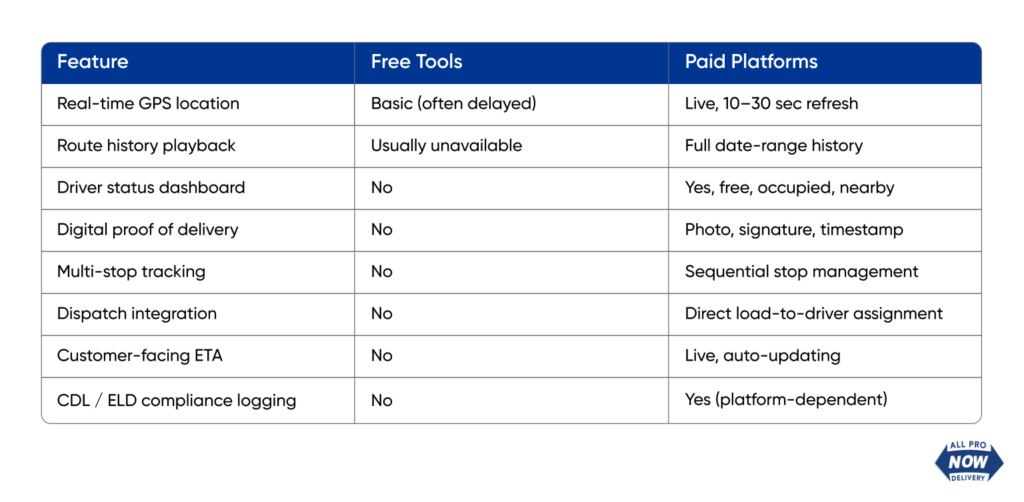
The gap between free driver tracking and a logistics-grade platform isn’t just feature depth. It’s the difference between knowing a driver left the yard and knowing exactly where they are, whether they’re on time, and having documentation when a customer disputes a delivery.
CDL Tracking and Last-Mile Delivery: What’s Different
Standard driver tracking monitors location and delivery status. CDL tracking applied to commercial driver’s license holders operating sprinter vans, box trucks, and regulated freight vehicles, adds compliance layers that consumer-grade apps don’t address.
CDL last-mile tracking and CDL delivery tracking need to account for:
- Hours of Service (HOS) compliance: Commercial drivers have federally regulated limits on drive time. ELD (Electronic Logging Device) integration logs hours automatically and flags compliance risks before they become violations.
- Chain-of-custody documentation: For medical freight, legal documents, and regulated cargo, the delivery record needs to show who handled the shipment, when, and where, not just that it arrived.
- Multi-stop route efficiency: CDL last-mile delivery often involves multiple drop-offs across a metro area. A good platform tracks each stop’s completion sequentially, not just the final destination.
- Route accountability: Fuel is expensive. Managers need to confirm that drivers are taking the most efficient routes, and they need route history data to back that up when questions arise.
Trucker tools tracking has become a popular category as independent CDL operators look for apps that handle both GPS visibility and load management from a single interface. The best platforms in this space connect dispatch, tracking, documentation, and invoicing in one workflow rather than requiring drivers to juggle multiple apps.
How AllProNow Handles Driver Tracking Across Seven States
AllProNow is an online freight management platform headquartered in Westlake, Ohio, with over 50 years of logistics experience. The platform connects shippers with a professional driver network and includes real-time driver tracking built into every single shipment, no premium add-on, no separate subscription.
Here’s how driver tracking works inside the AllProNow system:
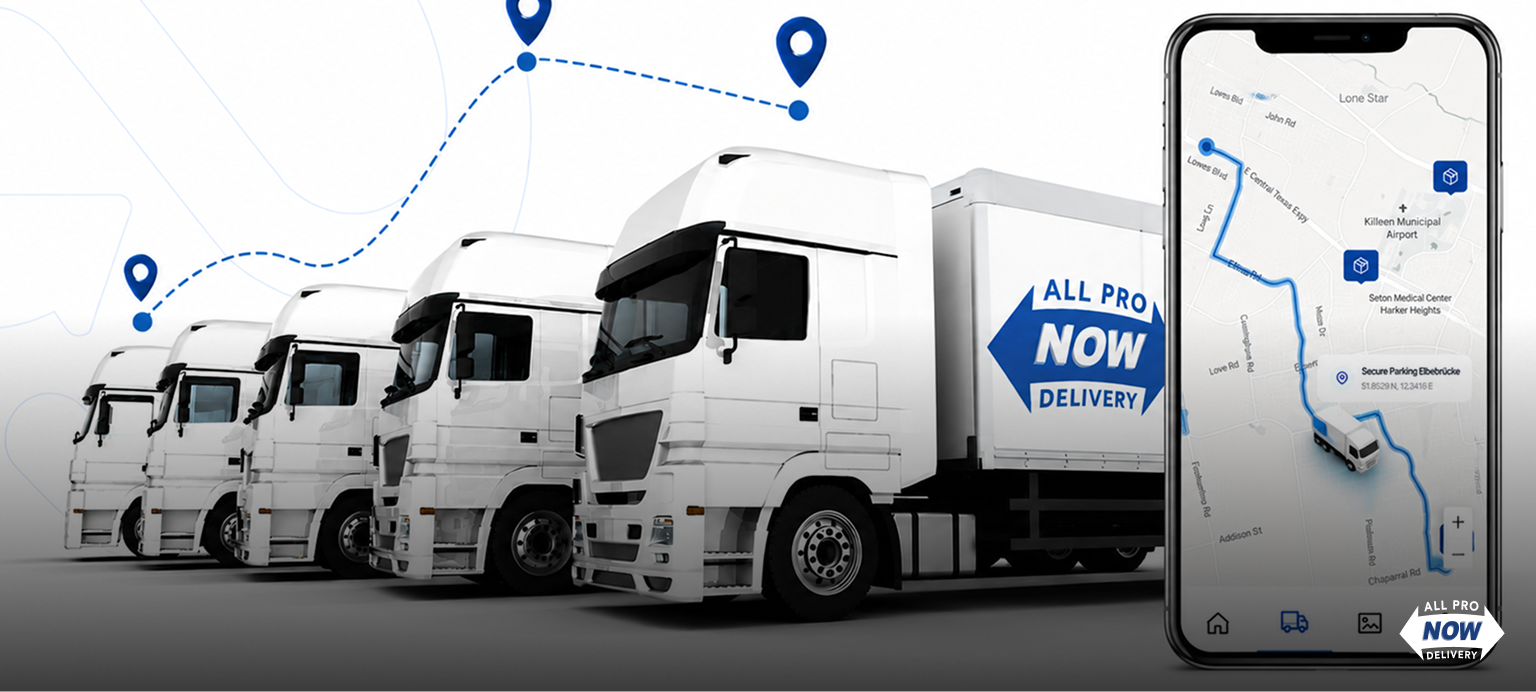
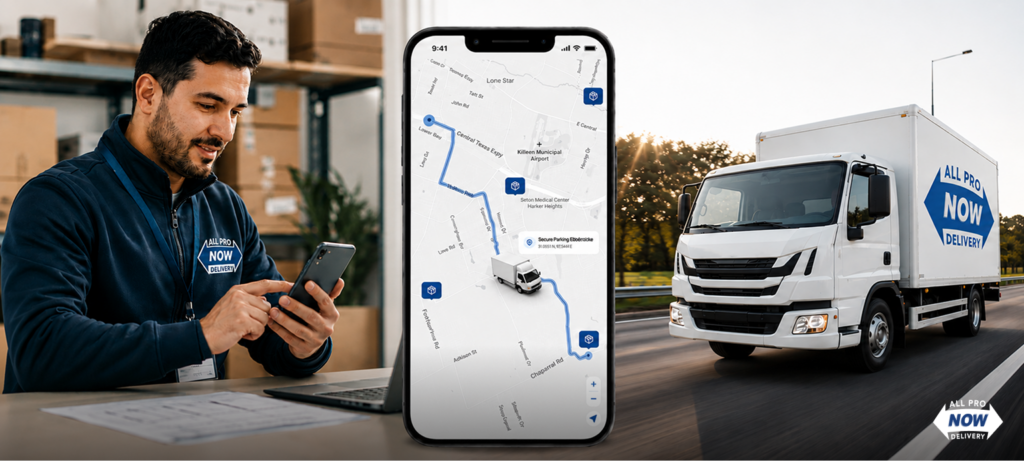
Live GPS Visibility: Once a load is matched and accepted, shippers see their driver’s live location on a map with a continuously updated ETA. There’s no need to call dispatch or the driver for a status update.
Available and Occupied Driver Status: AllProNow’s dispatch system shows which drivers are free, which are currently on trips, and which are nearest to any given pickup point. Admins can match unassigned loads to nearby available drivers directly from the portal. If no drivers are available near a pickup location, the system surfaces immediately, so dispatchers can act rather than wait.
Digital Proof of Delivery: Every delivery on AllProNow is documented with a photo, digital signature, and timestamp uploaded directly by the driver. Shippers access these records online anytime, eliminating paperwork and removing ambiguity from disputed deliveries.
Multi-Stop Shipments: AllProNow supports multiple pickups and drop-offs on a single order, with tracking active across every stop. This makes it practical for CDL delivery tracking across metropolitan routes.
Coverage Across Seven States: AllProNow operates across Ohio, Michigan, Pennsylvania, Indiana, Kentucky, New York, and Florida, covering more than 25 major cities including Columbus, Cleveland, Toledo, Akron, Canton, Youngstown, Detroit, Pittsburgh, Indianapolis, Philadelphia, Allentown, Harrisburg, Miami, Orlando, Tampa, Jacksonville, and Fort Lauderdale. Businesses shipping across this region get consistent, documented, tracked delivery without managing multiple carrier relationships.
Vehicle Options: The AllProNow driver network includes sprinter vans (ideal for parcels and small LTL up to 4 skids) and box trucks (for larger LTL loads up to 12 skids), with rush options available for time-critical freight.
Driver Tracking Across AllProNow’s Key Industries
Different industries have different stakes when a driver goes dark. Here’s what driver tracking means in each of the core markets AllProNow serves.
| Industry | Primary Driver Tracking Need | Key Cities Served |
| Healthcare / Medical | Chain-of-custody, time-critical specimen/medication delivery | Cleveland, Columbus, Detroit, Pittsburgh |
| Manufacturing / Industrial | Just-in-time parts delivery, production schedule protection | Toledo, Akron, Canton, Youngstown |
| Retail / E-Commerce | Live customer ETAs, first-attempt delivery success | Columbus, Detroit, Indianapolis, Philadelphia |
| Construction | Materials delivery confirmation, job-site scheduling | Pittsburgh, Youngstown, Northern Kentucky |
| Legal / Financial | Timestamped proof of delivery for court filings | Pittsburgh, Philadelphia, Allentown |
| Medical / Lab (Florida) | Same-day specimen transport, regulated handling | Miami, Orlando, Tampa, Jacksonville |
A manufacturer in Toledo running automotive parts can’t afford to find out at 3 PM that a delivery didn’t happen. A diagnostic lab in Columbus sending specimens to Pittsburgh needs a chain-of-custody record, not a tracking number that shows “out for delivery.” A law firm in Philadelphia needs a time-stamped signature, not a driver’s verbal confirmation.
AllProNow’s real-time driver tracking system gives each of these businesses what they need, consistently, across every shipment.
What to Look for in a Driver Tracking App
Not all driver tracking apps deliver the same visibility. Whether you’re evaluating AllProNow or any other platform, these are the features that separate a real solution from a dot on a map.
GPS refresh rate: Updates every 10 to 30 seconds are the standard for live delivery visibility. Anything slower limits your ability to give accurate ETAs.
Route history by date: You should be able to pull any driver’s route from any past day. This is essential for accountability reviews, customer disputes, and CDL compliance audits.
Driver status dashboard: Dispatchers need to see which drivers are free, which are occupied, and where they are, without making phone calls.
Proof of delivery documentation: GPS location alone isn’t proof. Digital signature, delivery photo, and timestamp combined create the documentation chain that protects both shippers and carriers.
Multi-stop management: If you’re running CDL delivery tracking with multiple drop-offs per route, the platform needs to track completion at each stop sequentially.
Dispatch integration: Tracking is most valuable when it’s connected to assignment. The ability to see who’s available and assign trips from the same interface removes the friction of managing tracking and dispatch separately.
Driver Tracking and Insurance: What Fleet Operators Should Know
Insurance-based driver tracking programs have generated significant discussion among fleet operators and business owners. The experience varies considerably by program and methodology.
Programs that use fair, data-rich scoring, weighing context rather than flagging every braking event as an incident, tend to generate genuine savings and driver buy-in. Programs that use pass/fail models, flag normal driving behavior as violations, or penalize drivers for events beyond their control tend to generate resentment and sometimes result in higher premiums rather than lower ones.
The real-world lesson for fleet managers: the quality of the tracking algorithm matters as much as the fact of tracking. Hard braking triggered by a sudden lane change from another driver is not the same as reckless driving, and a good system distinguishes between them. Drivers who know their performance is being assessed fairly are more likely to engage with the data constructively. Drivers who feel the system is set against them will look for ways around it.
Fleet managers can monitor speeding, harsh braking, rapid acceleration, and other risky driving patterns as they happen, and this immediate awareness allows for prompt intervention and coaching, preventing accidents before they occur. The goal isn’t surveillance. It’s creating a culture where good drivers are recognized and operational gaps are caught early.
How to Check Your Driver’s Status: A Practical Walkthrough
For businesses using AllProNow’s shipper portal, the process is direct:
- Log into the portal and navigate to active shipments.
- Select the shipment you want to track.
- The map view displays your driver’s live location with a real-time ETA.
- Driver status, free, occupied, or en route, is visible from the dispatch dashboard without contacting anyone.
- Once delivery is complete, the proof of delivery record (photo, signature, timestamp) is available immediately in the portal.
There’s no driver tracking number to search. There’s no waiting for a status scan. The data updates continuously, and the documentation is automatic.
Driver Tracking vs. A Tracking Number: Understanding the Difference
Many shippers look for a “driver tracking number” the same way they’d look up a UPS or FedEx tracking number, a static code that shows milestone updates. Modern driver tracking is fundamentally different.
A traditional tracking number shows checkpoint events: picked up, in transit, out for delivery, delivered. There’s no live location, no ETA that updates with traffic, and no documentation until the final scan.
A real-time driver tracking system shows the driver’s exact position on a map, with an ETA that updates every 30 seconds or less based on actual road conditions. When the delivery is complete, the system generates digital proof, not just a “delivered” status flag, but a photo, a signature, and a GPS-verified timestamp.
For businesses running same-day delivery across Ohio, Michigan, and Pennsylvania, that distinction isn’t technical. It’s the difference between knowing a shipment arrived and being able to prove it.
Driver Tracking That Delivers Real Accountability
Blind spots in your delivery operation are expensive. A driver who went the wrong way, a delivery that happened at the wrong location, a customer who never got an ETA, these aren’t just service failures. They’re operational costs that compound over time.
Driver tracking in 2026 gives businesses real-time visibility to eliminate those blind spots. Done well, it rewards good drivers, helps dispatchers respond in real time, and gives customers the live updates they now expect as standard.
AllProNow includes real-time driver tracking on every shipment across its seven-state network, built into the platform, not bolted on. Whether you’re shipping medical freight from Columbus, industrial parts from Toledo, legal documents in Pittsburgh, or e-commerce parcels across Florida, every load comes with live GPS visibility, a matched and verified driver, and digital proof of delivery.
Ready to put driver tracking to work for your business? Visit allpronow.net to get an instant quote and start your first fully tracked shipment today.