Delivery companies face mounting pressure. Fuel costs continue climbing. Driver shortages strain operations. Customer expectations demand faster service with perfect accuracy. Manual fleet coordination—spreadsheets, phone calls, guesswork—can’t keep pace.
There’s a solution: modern fleet management operations. Companies implementing GPS tracking, route optimization, and preventive maintenance systems report 25-35% cost reductions, 15% fuel savings, and 95%+ on-time delivery rates. These aren’t marginal gains. They’re operational transformations.
Fleet management combines GPS tracking, route optimization, fuel monitoring, driver behavior analysis, and preventive maintenance into one integrated system. The technology processes data humans can’t analyze manually, traffic patterns, vehicle diagnostics, driver performance, maintenance schedules, and turns it into actionable decisions.
At All Pro Now, we manage hundreds of delivery vehicles across Ohio and Florida daily. Our fleet management system helps businesses in Cleveland, Columbus, Tampa, and Miami cut costs while improving service quality. We’ve seen which strategies deliver results and which waste resources.
This guide breaks down fleet management operations that separate profitable delivery companies from struggling competitors.
What Fleet Management Operations Actually Include
Fleet management covers every aspect of running delivery vehicles efficiently. Not just tracking where trucks are, but understanding why certain routes cost more, which drivers perform best, and when vehicles need service before they break down.
What Fleet Management Operations Actually Include
Fleet management involves coordinating vehicles, drivers, routes, and maintenance to keep deliveries reliable and costs under control. It goes far beyond knowing where a vehicle is—it’s about understanding operational patterns, cost drivers, and risks before they turn into problems.
Modern fleet operations rely on digital platforms to centralize data and improve visibility. All Pro Now fits into this ecosystem by helping fleets manage and monitor daily delivery operations more effectively.
Vehicle Tracking and Operational Visibility
One of the foundations of fleet management is vehicle visibility. Knowing where vehicles are helps dispatchers respond to delays, communicate with customers, and verify completed jobs.
Fleet systems often use GPS data to:
- Monitor vehicle movement
- Review trip history
- Identify delays or excessive idle time
When fleets analyze this data, they frequently uncover inefficiencies such as extended idling at job sites or unnecessary detours. Addressing these patterns can reduce fuel usage, engine wear, and wasted labor time.
All Pro Now supports operational visibility by helping teams stay informed about vehicle activity and job progress throughout the day, enabling better coordination between drivers and dispatch.
Routing, Dispatching, and Daily Planning
Efficient routing plays a major role in controlling fleet costs. Poorly planned routes increase fuel consumption, driver hours, and vehicle wear.
Fleet management operations typically focus on:
- Logical stop sequencing
- Reducing backtracking
- Adjusting plans when delays occur
Even small reductions in daily mileage can lead to significant annual savings. Digital dispatch and planning tools help teams make faster decisions and reduce manual guesswork.
All Pro Now helps streamline dispatch and job coordination, making it easier to manage daily routes, assignments, and schedule changes as operations evolve.
Fuel Awareness and Cost Control
Fuel is one of the largest ongoing expenses in any fleet operation. Effective fleet management involves:
- Monitoring fuel usage trends
- Identifying inefficient driving behavior
- Preventing misuse or unauthorized fuel purchases
When fuel data is reviewed consistently, fleets can spot issues early and make informed decisions about vehicles, routes, and driver habits.
All Pro Now contributes to cost awareness by giving operators better insight into daily fleet activity, which supports smarter fuel and operational decisions.
Driver Performance and Accountability
How vehicles are driven directly impacts safety, fuel costs, and maintenance expenses. Fleet management operations commonly track:
- Speeding patterns
- Harsh braking or acceleration
- Excessive idling
- Compliance with work schedules
When expectations are clear and performance is visible, driver behavior often improves. Transparency creates accountability and encourages safer, more efficient driving habits.
All Pro Now helps establish operational accountability by providing data that supports driver oversight and performance discussions, without relying on assumptions.
Preventive Maintenance and Downtime Reduction
Unplanned vehicle breakdowns are expensive and disruptive. Strong fleet operations emphasize preventive maintenance to:
- Reduce emergency repairs
- Extend vehicle lifespan
- Avoid missed deliveries
Tracking service intervals and responding early to warning signs keeps vehicles on the road when they’re needed most.
All Pro Now supports proactive operations by helping teams stay organized and informed, reducing the likelihood of costly surprises.
How Fleet Management Operations Cut Operating Costs
The combination of these systems creates compounding savings. Optimized routes reduce mileage. Better driving reduces fuel consumption per mile. Preventive maintenance prevents expensive failures. The savings add up fast.
Annual Cost Savings Example: 10-Vehicle Fleet
| Cost Category | Before Fleet Management | After Fleet Management | Annual Savings |
| Fuel Costs | $60,000 | $45,000 | $15,000 |
| Maintenance | $28,000 | $18,000 | $10,000 |
| Insurance (fewer accidents) | $24,000 | $21,000 | $3,000 |
| Downtime/Lost Revenue | $15,000 | $4,000 | $11,000 |
| Compliance Fines | $8,000 | $500 | $7,500 |
| Total Annual Costs | $135,000 | $88,500 | $46,500 |
| Cost Reduction Percentage | – | – | 34.4% |
These aren’t hypothetical numbers. This reflects real savings from an Orlando delivery company with 10 vehicles. They invested $12,000 in fleet management software and equipment. The system paid for itself in three months. Annual savings now exceed $46,000.
Fleet Management Technology That Actually Works
Technology should simplify operations, not complicate them. The best fleet management systems integrate seamlessly with existing workflows.

GPS Tracking and Real-Time Monitoring
Basic GPS tracking shows vehicle locations on a map. Advanced systems show:
- Current speed and direction
- Stops with timestamps and duration
- Geofence violations (unauthorized areas)
- Route adherence vs. planned route
- ETA calculations for each stop
All Pro Now provides customers with live tracking links. A Columbus manufacturer can watch their urgent shipment move from Toledo to their facility. No phone calls asking “where’s my package?” needed.
Mobile Apps for Driver Communication
Drivers need route information, delivery instructions, and customer contacts without calling dispatch. Mobile apps provide:
- Turn-by-turn navigation
- Delivery manifests with customer details
- Digital proof of delivery with signatures and photos
- Two-way messaging with dispatch
- Break and meal period tracking
This eliminates 60% of dispatch phone calls. Drivers spend more time driving, less time on hold with dispatch asking basic questions.
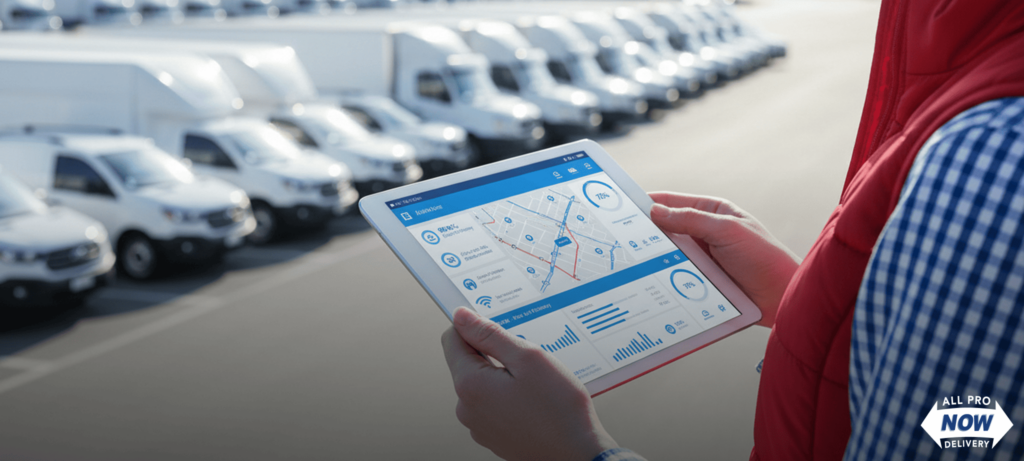
Integrated Dashboards and Reporting
Fleet managers don’t have time to dig through raw data. Dashboards show key metrics at a glance:
- Current vehicle locations and status
- On-time delivery percentage
- Fuel consumption trends
- Maintenance upcoming and overdue
- Driver performance scores
- Cost per mile by vehicle
Reports generate automatically. Monday morning you get last week’s performance summary. Month-end shows detailed cost breakdowns by vehicle and driver.
Artificial Intelligence and Predictive Analytics
Modern fleet management uses AI to predict problems before they happen:
- Vehicles likely to need maintenance based on driving patterns
- Routes likely to experience delays based on historical traffic
- Drivers at risk of accidents based on behavior trends
- Optimal vehicle replacement timing based on maintenance costs
A Tampa company uses AI to predict tire failures. The system analyzes tire pressure data, mileage, and driving patterns. It flags tires likely to fail within 1,000 miles. Drivers replace them during scheduled stops instead of dealing with roadside flats during deliveries.
Regional Considerations for Ohio and Florida Fleet Operations
Geography and climate affect fleet management differently across regions. What works in Cleveland doesn’t always work in Miami.
Ohio Fleet Challenges
Winter weather creates unique problems. Road salt corrodes undercarriages and brake lines. Cold temperatures drain batteries faster. Snow and ice increase accident risks.
Ohio fleets need:
- More frequent undercarriage washing
- Battery testing before winter
- Winter tire programs
- Additional routing time during snow events
- Salt damage inspection protocols
Cleveland and Toledo routes require 15-20% additional time allowances during winter months. All Pro Now adjusts schedules seasonally to maintain on-time delivery despite weather.
Manufacturing and industrial density means higher commercial vehicle traffic. Dock appointments run tight schedules. Missing your window costs hours in delays.
Fleet management systems integrate with customer docks. Drivers receive dock appointment confirmations through mobile apps. GPS tracking verifies arrival times.
Florida Fleet Challenges
Heat and humidity destroy vehicles faster. Air conditioning runs constantly. Engines overheat in traffic. Humidity promotes rust and mold.
Florida fleets need:
- Enhanced cooling system maintenance
- More frequent AC service
- Corrosion prevention treatments
- Interior mold prevention protocols
Miami and Tampa vehicles need AC service twice annually versus once in Ohio. Cooling system flushes prevent overheating during summer traffic jams.
Hurricane season disrupts operations June through November. Routes close. Customers evacuate. Deliveries get delayed or canceled.
Fleet management systems help with disaster planning:
- Vehicle location tracking during evacuations
- Alternative route planning around flooded areas
- Fuel level monitoring to ensure full tanks before storms
- Real-time communication with drivers in affected areas
A Jacksonville delivery company evacuated their entire fleet to Georgia before Hurricane Ian. GPS tracking confirmed all vehicles reached safety. No storm damage losses.
Tourism traffic clogs roads in Orlando, Tampa, and Miami Beach. I-4 between Tampa and Orlando becomes a parking lot. Beach routes slow to a crawl.
Route optimization accounts for tourism patterns. Thursday evening deliveries in tourist areas get scheduled earlier. Weekend routing avoids beach communities during peak hours.
All Pro Now’s Fleet Management Approach
We’ve been managing delivery fleets across Ohio and Florida for decades. Our system combines proven technology with regional expertise.
Every All Pro Now vehicle has GPS tracking and telematics. Customers see real-time delivery progress through our platform. Drivers receive optimized routes considering current traffic, delivery windows, and vehicle capacity.
Our maintenance schedules prevent breakdowns. Vehicles get serviced based on mileage and engine hours, not calendar dates. This keeps our 95%+ on-time delivery rate consistent.
Driver performance gets monitored but not micromanaged. We coach drivers using data, not assumptions. Safe, efficient drivers earn performance bonuses. This creates a culture of excellence rather than fear.
We handle same-day delivery, courier services, LTL freight, and parcel delivery throughout our service areas. Whether you’re shipping from Cleveland to Columbus or Tampa to Miami, our fleet management ensures reliable, cost-effective delivery.
Regional knowledge matters. We know which Columbus neighborhoods have dock restrictions. We understand Tampa traffic patterns during cruise ship departures. We plan Orlando routes around theme park shifts.
Get Instant Pricing with Our Online Calculator
All Pro Now offers an instant price calculator on our website. Enter your pickup location, delivery address, package details, and desired delivery speed to get accurate pricing in seconds.
The calculator shows exactly what your delivery will cost based on distance, service type, package size, and current demand. No hidden fees. No surprise charges. Book instantly or call our team for custom quotes on complex shipments.
Implementing Fleet Management for Your Business
You don’t need a 50-truck fleet to benefit from fleet management. Even three-vehicle operations see measurable savings.
Start by tracking current costs accurately. Document fuel expenses, maintenance costs, insurance premiums, and downtime. This creates your baseline for measuring improvement.
Choose fleet management software matching your needs. Small fleets need basic GPS tracking and maintenance scheduling. Larger operations need advanced analytics and compliance management. Don’t overpay for features you won’t use.
Install hardware professionally. GPS devices need proper mounting. Wiring should integrate with vehicle systems cleanly. Poor installations cause false alerts and device failures.
Train drivers thoroughly. Explain how the system benefits them—safer routes, better scheduling, performance bonuses. Get buy-in before going live. Drivers who understand the why cooperate more than those just told what to do.
Monitor results weekly at first, then monthly. Track metrics that matter: cost per mile, on-time delivery percentage, fuel economy, maintenance costs. Adjust based on data, not gut feelings.
Most businesses see ROI within 3-6 months. A five-vehicle fleet spending $5,000 on fleet management typically saves $15,000-$20,000 annually. The math works.
Common Fleet Management Mistakes to Avoid
We’ve seen companies sabotage fleet management implementation through avoidable errors.
Choosing software that doesn’t integrate. Your fleet management system should connect with accounting software, customer management systems, and dispatch platforms. Standalone systems create double data entry and errors.
Ignoring driver concerns. Drivers feel micromanaged when GPS tracking appears suddenly. Involve them early. Explain safety benefits and performance incentives. Make them partners in improvement.
Tracking everything without using data. Collecting 100 metrics but acting on none wastes time and money. Pick 5-10 key performance indicators and actually use them for decisions.
Skipping maintenance to save money. Fleet management identifies maintenance needs earlier. Ignoring these alerts defeats the purpose. Preventive maintenance costs less than breakdowns, always.
Not adjusting for regional differences. Routes in Toledo need different time allowances than routes in Tampa. Winter scheduling differs from summer scheduling. One-size-fits-all routing fails.
Forgetting about driver retention. Good drivers are expensive to replace. Recruiting, training, and learning curves cost thousands per driver. Fleet management should improve working conditions, not create hostile environments.
A Michigan company installed fleet management but used it only to punish drivers. Speeding incidents triggered automatic write-ups. Harsh braking created investigations. Within six months, they lost their four best drivers. Delivery quality collapsed. They learned the hard way that data should guide coaching, not create fear.
The Future of Fleet Management Operations
Technology keeps improving, creating new opportunities for efficiency.
Electric vehicles are changing fleet economics. Lower fuel costs offset higher purchase prices. Maintenance costs drop without oil changes and transmission services. Fleet management systems now track battery health, charging patterns, and range optimization.
A Columbus delivery company added three electric vans to their fleet. Operating costs dropped from $0.60 per mile to $0.22 per mile. The fleet management system optimizes charging schedules based on delivery routes and electricity rates.
Autonomous vehicle technology is still years from widespread delivery use, but platooning systems already work. Fleet management coordinates multiple trucks following each other closely, reducing aerodynamic drag and fuel consumption 10-15% on highway routes.
Artificial intelligence keeps getting smarter. Route optimization now considers weather predictions, historical traffic patterns, customer behavior, and even social media events that might affect traffic. A concert letting out or a sports game ending gets factored into routing automatically.
These advances make fleet management even more valuable. Companies investing in modern systems now position themselves for future innovations.
Take Control of Your Fleet Costs Today
Fleet management operations determine whether you profit or struggle in delivery logistics. GPS tracking, route optimization, preventive maintenance, and driver monitoring cut costs 25-35% while improving service quality.
All Pro Now provides same-day delivery, courier services, LTL freight, and parcel delivery across Ohio and Florida using advanced fleet management systems. Our technology and regional expertise help businesses in Cleveland, Columbus, Toledo, Tampa, Miami, and Orlando reduce costs while improving delivery performance.
Whether you operate your own fleet or work with delivery partners, understanding fleet management helps you make smarter logistics decisions.
Ready to cut your delivery costs and improve service? Visit AllProNow.net to get instant quotes, book shipments, and learn how our fleet management systems benefit your business. Use our instant price calculator for transparent pricing with no hidden fees. Let’s make your logistics more efficient.