

A missed lab specimen. A delayed pharmaceutical shipment. A medical device that arrives at a Tampa hospital two hours after a procedure window closes. Medical delivery services aren’t logistics in the conventional sense, they are clinical infrastructure. When they work, no one notices. When they fail, the consequences reach patients.
The global medical supply delivery service market was valued at $70.79 billion in 2024. It’s projected to reach $143.89 billion by 2034, growing at 7.53% annually. North America leads that market, and the Midwest holds over 25% of the U.S. healthcare third-party logistics market share. For hospitals, laboratories, pharmacies, and medical device distributors operating across Ohio, Michigan, Indiana, Pennsylvania, Kentucky, and Florida, that growth reflects a structural shift: healthcare organizations are increasingly outsourcing medical delivery services to specialized carriers rather than managing logistics internally.
This guide covers what medical delivery services actually require, where compliance gaps create operational and legal exposure, and what separates a carrier that can genuinely support healthcare freight from one that can’t.
What Medical Delivery Services Actually Cover
Medical delivery services is a broad term applied to a narrow set of operational requirements. Understanding the distinct categories prevents healthcare operations from using a general courier where a compliant specialist is required.
Lab specimen and sample transport: Blood draws, tissue samples, urinalysis, and pathology specimens move between collection points, hospitals, and reference laboratories on tight windows. Specimen integrity depends on time, temperature control, and chain-of-custody documentation from pickup to receipt. A specimen delivered 40 minutes late to a Cleveland reference lab doesn’t just miss the processing window. It invalidates the sample and triggers a repeat collection.
Pharmaceutical and prescription delivery: Medications, biologics, and specialty pharmaceuticals require documented handling, tamper-evident packaging, and delivery confirmation that satisfies both HIPAA and chain-of-custody requirements. Temperature-sensitive biologics add cold-chain compliance to the documentation requirement.
Medical device and equipment delivery: Surgical instruments, diagnostic equipment, and hospital supply replenishment move between manufacturers, distributors, hospitals, and surgical centers. This freight category combines time-critical delivery windows with equipment handling requirements that general parcel carriers aren’t built to manage.
Medical records and PHI transport: Physical documents containing protected health information (PHI) must move under strict access controls, tamper-evident conditions, and documented chain-of-custody logs. HIPAA compliance applies to the courier as a business associate, not just the healthcare organization originating the shipment.
Each category has different compliance requirements. A carrier that handles pharmaceutical delivery correctly may not have the chain-of-custody protocols required for specimen transport. A courier managing medical records shipments faces HIPAA obligations that general freight carriers don’t encounter. Understanding which category your freight falls into determines which compliance standards your carrier must meet.
HIPAA Compliance in Medical Delivery Services: What It Actually Requires
HIPAA compliance for medical delivery services is not a certification on a wall. It is a documented operational framework that applies every time a courier handles Protected Health Information.
The Department of Health and Human Services’ Office for Civil Rights enforces HIPAA compliance through civil penalties ranging from $100 to $50,000 per violation. Willful violations carry criminal penalties of $50,000 to $250,000 per violation, plus 1 to 10 years in prison. Each violation is processed separately. A single shipment mishandled across multiple PHI documents creates multiple violations.
For medical delivery services, HIPAA compliance requires:
Business Associate Agreements (BAAs): Any courier handling PHI must sign a BAA with the healthcare organization. This isn’t optional. It’s a legal requirement that defines the courier’s PHI protection responsibilities before the first delivery is made.
Chain-of-custody documentation: Every handoff must be logged with timestamps, personnel identification, and location data. For healthcare organizations, chain-of-custody logs are the evidence trail that demonstrates PHI was handled by authorized personnel only, from pickup through final delivery.
Secure transportation methods: PHI must travel in tamper-evident packaging, locked compartments, or sealed containers that prevent unauthorized access during transit. GPS tracking of the vehicle provides an additional layer of documented chain-of-custody evidence.
Digital proof of delivery: Paper POD creates chain-of-custody gaps. Digital proof of delivery, GPS-stamped, photo-documented, and captured at the exact point of delivery, creates the auditable record that HIPAA and clinical operations require. A courier that still uses paper delivery confirmation is not equipped for healthcare compliance.
Driver training: Couriers handling PHI must complete HIPAA training covering PHI recognition, secure handling protocols, breach reporting requirements, and chain-of-custody procedures. Background-checked drivers with documented training aren’t a premium feature in medical delivery services. They’re a baseline compliance requirement.
Non-compliance doesn’t just expose the courier to penalties. It exposes the healthcare organization that contracted the courier to the same liability. Hospitals, laboratories, and pharmacies that work with non-compliant delivery services bear joint responsibility for PHI breaches that occur during transit.
The Real Cost of Medical Delivery Failure
Medical delivery service failures don’t appear on a single line item. They distribute across clinical operations, compliance exposure, and patient outcomes in ways that are difficult to quantify until they happen.
| Failure Type | Operational Impact | Compliance Exposure |
| Late specimen delivery | Sample invalidated, repeat collection required | None if documented — patient care delay |
| PHI delivered to wrong address | Chain-of-custody broken, patient data exposed | HIPAA violation — $100–$50,000 per record |
| Pharmaceutical delivery delay | Patient treatment delayed, pharmacy inventory disrupted | None unless controlled substances involved |
| Medical device late to OR | Procedure delayed or rescheduled, OR time lost | None — facility cost exposure |
| Paper POD instead of digital | Chain-of-custody gap, invoice dispute | HIPAA gap — audit trail incomplete |
| Untrained driver handles PHI | PHI exposure risk during transit | HIPAA violation if breach occurs |
| No real-time tracking | Exception discovered after delivery window closes | Compliance and clinical risk both increase |
For a Columbus hospital managing 50 daily specimen pickups across multiple collection sites, a carrier without real-time tracking creates exception management gaps that paper logs don’t resolve. For a Miami pharmaceutical distributor managing temperature-sensitive biologics on the Ohio-to-Florida corridor, a carrier without digital POD and GPS-confirmed delivery creates chain-of-custody documentation gaps that regulatory audits will find.
These aren’t worst-case scenarios. They are standard operational risks for healthcare organizations using general freight carriers for medical delivery services.
Medical Delivery Services Across Key Healthcare Markets
The operational requirements of medical delivery services look different depending on the healthcare market and the freight category being moved.
Cleveland and Northeast Ohio: Cleveland Clinic, University Hospitals, and MetroHealth operate one of the highest-density healthcare ecosystems in the Midwest. Specimen transport between satellite collection sites and central reference laboratories runs on tight processing windows. Medical device replenishment for Northeast Ohio surgical centers requires same-day delivery capability with documented proof of receipt that OR scheduling can rely on.
Columbus: Ohio State University Wexner Medical Center and OhioHealth anchor Columbus’s healthcare logistics demand. Pharmaceutical distribution and medical supply replenishment in Columbus operates across a broad geographic footprint, suburban collection sites, outpatient surgical centers, and specialty clinics spread across Franklin County and surrounding areas. Route efficiency and delivery window consistency matter as much as compliance documentation.
Toledo and Northwest Ohio: ProMedica and Mercy Health drive Toledo’s healthcare logistics volume. Toledo’s position on the Michigan-Ohio border creates interstate delivery requirements for medical freight moving between Ohio healthcare systems and Michigan-based suppliers and reference laboratories.
Tampa, Miami, and Orlando: Florida’s healthcare market is shaped by its demographics, one of the highest concentrations of elderly patients in the U.S. and its geography. Miami’s density creates last-mile complexity. Tampa’s position as a regional healthcare hub generates regular freight on the Ohio-to-Florida corridor for medical device and pharmaceutical distribution. Orlando’s growth as a healthcare market has expanded the demand for reliable same-day medical delivery services across Central Florida.
Ohio to Florida corridor (I-75): The 1,100–1,200 mile lane between Ohio’s healthcare manufacturing base and Florida’s healthcare delivery infrastructure is one of the most operationally significant regional lanes for medical delivery services. Medical device manufacturers in Akron, Columbus, and Toledo ship to Florida hospital systems and distributors on this corridor regularly. A carrier without dedicated commercial fleet capacity on this lane and without the compliance documentation that healthcare freight requires, creates risk on every shipment.
Technology Requirements for Medical Delivery Services
The technology infrastructure a carrier operates directly determines whether it can meet healthcare compliance requirements, not just delivery speed.
| Technology Component | What It Does | Why It Matters for Healthcare |
| Live GPS tracking | Location updated every 60–90 seconds during transit | Chain-of-custody documentation — exact location at all times |
| Digital proof of delivery | GPS-stamped, photo-documented, signature-captured at delivery | HIPAA-compliant delivery confirmation, eliminates paper POD gaps |
| Automated exception alerts | Detects route deviations and triggers alerts before windows close | Exception identified before specimen or pharmaceutical window closes |
| Encrypted tracking systems | Protects shipment and delivery data from unauthorized access | HIPAA Security Rule compliance for digital PHI |
| Tamper-evident packaging integration | Documents secure packaging at pickup | Chain-of-custody evidence from origin |
| Freight reporting | On-time delivery rates, exception frequency, lane performance | Healthcare operations require audit-ready delivery performance data |
A carrier that offers live GPS tracking without encrypted data transmission is not HIPAA-compliant on digital PHI. A carrier offering digital POD without GPS timestamp fails the chain-of-custody documentation standard. Healthcare organizations evaluating medical delivery services should require documentation of each technology component, not just a general statement that a carrier offers “real-time tracking.”
How to Evaluate a Medical Delivery Services Provider
The right carrier for healthcare freight isn’t the fastest or the cheapest. It’s the one that meets compliance requirements while delivering on the operational windows clinical schedules depend on.
| Evaluation Criteria | What to Ask | Red Flag |
| HIPAA compliance | Do they sign BAAs? Is training documented? | No BAA offered, training not verifiable |
| Chain-of-custody documentation | Is POD digital, GPS-stamped, and photo-confirmed? | Paper POD only |
| Driver qualification | Background checks? HIPAA training certificates? | No documentation available |
| Real-time tracking | GPS updates every 60–90 seconds? | Status only at pickup and delivery |
| Exception management | Automatic alerts before delivery windows close? | Coordinator must call to check status |
| Temperature control | Do they handle cold-chain freight if required? | One-size fleet, no temperature documentation |
| Pricing transparency | All-inclusive flat rate before booking? | Fuel and accessorial surcharges added post-booking |
| On-time performance data | Documented on-time rate by lane? | Aggregate national stats without regional breakdown |
The last two criteria matter specifically for healthcare budget management. A carrier quoting a base rate that doesn’t include fuel surcharges creates invoice surprises on every delivery cycle. A carrier citing national on-time performance without lane-specific data isn’t telling you what you need to know about Cleveland-to-Columbus specimen transport or Miami-to-Tampa pharmaceutical delivery windows.
How AllProNow Supports Medical Delivery Services Across Ohio and Florida
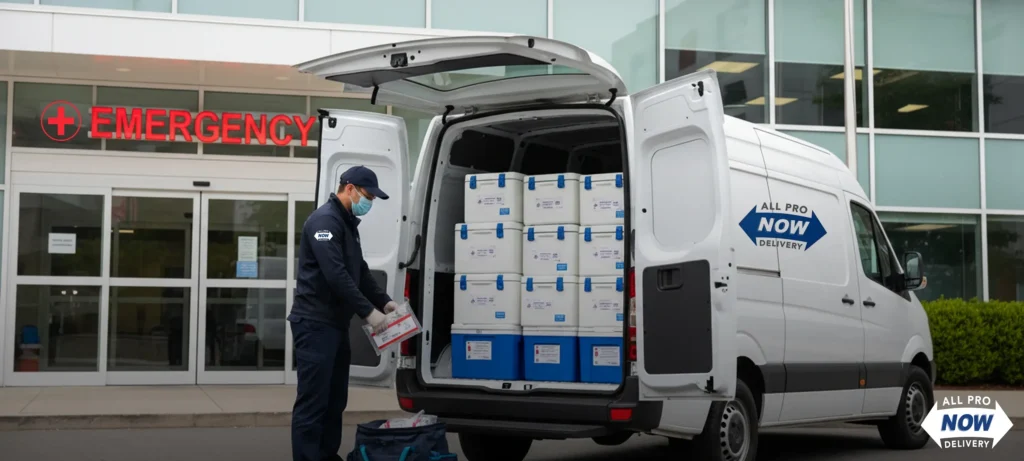
AllProNow serves healthcare operations across Ohio, Michigan, Indiana, Pennsylvania, Kentucky, and Florida with same-day and scheduled medical delivery services backed by a dedicated professional fleet, live GPS tracking updated every 60–90 seconds, digital proof of delivery with GPS timestamp and photo confirmation, and transparent flat-rate pricing with no post-booking surcharges.

The dedicated fleet — sprinter vans handling up to 3,600 lbs and box trucks handling up to 10,000 lbs — operates across Cleveland, Columbus, Toledo, Akron, Youngstown, Pittsburgh, Detroit, Indianapolis, Northern Kentucky, Tampa, Miami, and Orlando. With 50+ years of regional freight experience, 80,000+ shipments delivered, and 99% on-time performance, AllProNow’s healthcare delivery capability covers the clinical timing and compliance documentation requirements that medical freight demands.
For hospital systems managing specimen transport across Northeast Ohio. For pharmaceutical distributors running the Ohio-to-Florida corridor. For medical device companies delivering to Florida surgical centers from Midwest manufacturing facilities — AllProNow’s medical delivery services operate on the production and clinical schedules that healthcare cannot negotiate around.